/eh/2025-01-08/173633966714069467/picture.png)

/eh/2024-12-24/173503345348979036/Favorite-Icon.png)
/eh/2025-07-08/1751962110204480194/picture.png)
/eh/2025-06-21/1750485478958537574/countryInfoIcon.png)
/eh/2025-06-21/1750485741321434291/Hi-Sign-in-My-Nihao.png)
/eh/2025-06-21/1750485837193896318/cart.png)
/eh/2025-06-21/1750485968202533847/cart.png)
/eh/2025-04-17/1744862476612819675/hot-img.png)
/eh/2025-11-07/1762504524550532584/header-icon.jpg)
/eh/2025-07-07/1751875582852206790/header-icon.png)
/eh/2025-07-07/1751875587886277738/header-icon.png)

Best in 7 days


Shopping security

The DC-7 was Douglas’ last major piston engine-powered transport aircraft. Built 1953 - 1958, it entered the American Airlines flagship service on its New York-Los Angeles route, becoming the first airliner to offer nonstop transcontinental service in both directions, flying westbound against the prevailing winds. 44924 began its career with American Airlines in 1956, eventually being converted to a freighter in later years, most notably with Ortner Air Service in Ohio. Walter Soplata acquired its cockpit and other fuselage sections during the 1970s from the Ortners. MotoArt continues the dream to preserve the newest aircraft in the PlaneTags fleet.
Handmade Aviation Tags
PlaneTags are:
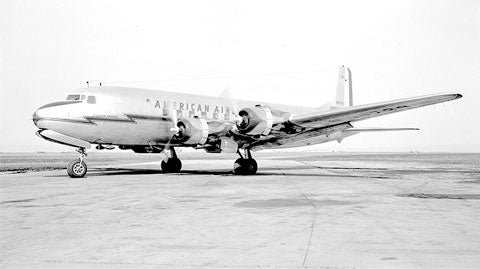
Originally introduced with 69 all first-class seating, the DC-7 was designed with a luxurious interior featuring tan, white, aqua and turquoise fabrics and leathers accented with gold and silver. The aircraft was said to “set the mood for a Millionaire Dream Vacation in such gay holiday spots as New Orleans, Jamaica and Havana”.

Passengers enjoyed large picture windows, improvements to air conditioning and sound proofing for additional comfort. Offering amenities travelers can only dream of today, the DC-7 had an eight-passenger Sky Room with facing seats as well as a five-seat Sky Lounge.
Designed when airlines were aiming for luxury in the sky, it was said that “The DC-7 flying today will supply the service and luxurious refinements expected from air transports of tomorrow.”
The Douglas DC-7 was the first commercial aircraft capable of flying passengers non-stop from east to west across the US against the jet stream. The flight took a little over 8 hours, but was unrealistically scheduled to land under the 8 hour mark in order to circumvent the Civil Air Regulations domestic flight crew limit of 8 hours flight time in any 24-hour period.
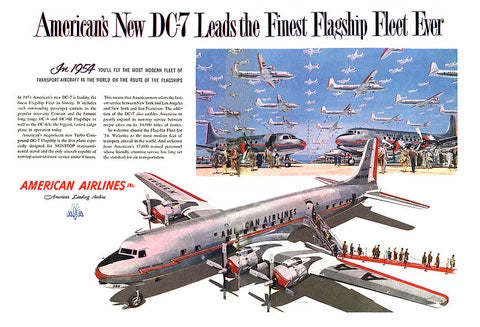
1954- sky full of planes - DC-7 flickr photo by x-ray delta one shared under a Creative Commons (BY-NC-SA) license
The fastest piston-powered commercial plane in 1954, the DC-7 boasted a speed of 6 miles a minute. It was also the first commercial aircraft built with heat-resistant and lightweight titanium. The DC-7 marked the end of an era as the last of Douglas’s piston engine airliner designs, beginning with the DC-2 in the 1930s. When replaced by jet aircraft in the late 60s, DC-7s found use with travel clubs and as fire fighting aircraft.

Joining the American Airlines fleet April 5, 1956, our DC-7B, Serial Number 44924 was converted to a freighter in September of 1959. After years of service, Walter Soplata received the cockpit, fuselage sections and wings from Ortner Air Service in the late 70s, the plane was then stored for over 3 decades on the Soplata farm in Newbury, Ohio.

Thanks to Mr. Soplata’s dedication to safeguarding and collecting some of the most iconic aircraft ever produced in the U.S. PlaneTags is now able to save this historic aircraft from further decay by offering a piece of quintessential aviation history to enthusiasts and collectors who share this passion.
- Please Note: Due to limited quantities, combination colors you may receive will vary.
*Important Notice – Please Read Carefully
PlaneTags are made from actual retired aircraft fuselage, not merely stamped metal. Because PlaneTags are made from real fuselage, each PlaneTag bears the color, thickness, and wear and tear from the portion of the fuselage from which it was cut and it is therefore rare to create two identical PlaneTags. These variations and imperfections are not product flaws. They are part of the beauty of PlaneTags. As a result, you will not have an option to select the color of your PlaneTag. The images on this website are provided for reference only and should not be used as the sole basis for choosing a particular PlaneTag.
Ships within 48 hours · Estimated delivery Jun 24 - Jun 29
US$40
Get nowSign up to your membership to get coupons up to
15%
Get nowOpportunity to enjoy order discount up to 15% off
Top-Converting Item to Boost Your Average Order


